Causes of Poor Central Air Conditioning Performance in Large Buildings in Jubail 00201130495851 خدمة سريعة وبأرخص الأسعار
Learn about the causes of poor central AC performance in large buildings in Jubail, the main signs of reduced cooling efficiency, and common problems involving filters, ductwork, chillers, AHUs, and control systems, along with practical tips for maintaining HVAC system performance.
Causes of Poor Central Air Conditioning Performance in Large Buildings in Jubail
Central air conditioning is one of the most important systems used in large buildings in Jubail, including administrative buildings, commercial complexes, hotels, industrial facilities, and service buildings. With high temperatures during the summer months, air conditioning systems operate for long periods and under heavy loads. Therefore, any reduction in their efficiency can have a noticeable impact on indoor comfort, electricity consumption, and operating costs.
Poor central AC performance does not always begin suddenly. In many cases, the problem develops gradually, such as reduced cooling in certain areas, temperature differences between floors, longer operating times to reach the required temperature, or increased electricity consumption without any obvious change in building usage.
Central HVAC systems in large buildings rely on multiple components that work together, including cooling units, pumps, Air Handling Units (AHUs), Fan Coil Units (FCUs), air ducts, control systems, sensors, and chilled water systems in some facilities. Therefore, a problem in one component can affect the performance of other parts of the system.
The cause of poor cooling may be something as simple as dirty filters or coils, while in other cases the problem may be related to air duct leakage, a control system malfunction, or reduced efficiency of one of the cooling units.
For this reason, identifying the causes of poor central AC performance in large buildings in Jubail at an early stage can help address the problem before it develops into a major breakdown or leads to continuously increasing operating costs.
MaskanCare provides central air conditioning inspection and maintenance services and HVAC services for large buildings in Jubail, focusing on different system components and identifying the cause of poor performance before selecting the appropriate maintenance solution.
For contact and booking: 00201130495851
Best Central AC Inspection and Maintenance Company for Large Buildings in Jubail
When a central air conditioning system begins to lose efficiency, building managers or operating teams may notice that some rooms have become warmer than usual or that the system operates for longer periods without reaching the required temperature.
However, identifying the actual cause of the problem requires inspecting more than one component.
The issue may be related to the cooling unit itself, an Air Handling Unit, chilled water flow, filters and coils, air ducts, control systems, or sensors.
In large buildings, identifying the cause can be more complicated because of the extensive distribution network, multiple zones and floors, and numerous air handling units.
Field studies of HVAC systems in high-rise buildings have also shown that operational problems may be related to air and chilled water distribution systems, control strategies, and operating chillers at unsuitable loads, rather than being caused only by equipment failures.
For this reason, MaskanCare treats poor central AC performance as a problem involving an integrated system rather than simply a malfunction in a single unit.

Benefits of Central AC Inspection in Large Buildings in Jubail
Regular inspection of a central air conditioning system helps identify changes in system performance before they develop into major failures.
The main benefits of inspection include:
● Early detection of poor cooling: Identifying changes in system performance before a clear failure occurs.
● Monitoring AC units: Inspecting cooling units, Air Handling Units, and related components.
● Inspecting filters and coils: Ensuring that dirt and buildup are not affecting airflow or heat transfer.
● Checking air ducts: Looking for leaks or obstructions that may affect air distribution.
● Inspecting control systems: Checking sensors, controllers, and communication with the Building Management System (BMS), when available.
● Reducing unexpected breakdowns: Detecting problems before they cause system downtime.
● Improving cooling distribution: Identifying the causes of temperature differences between areas.
● Monitoring energy consumption: Detecting unusual increases in electricity consumption related to system performance.
● Extending component operating life: Preventive maintenance helps reduce unnecessary stress on equipment.
How Can You Tell That Your Central AC System Is Losing Efficiency?
Different signs may appear when a central air conditioning system begins to lose efficiency. Some of these signs can be noticed by building staff or occupants before a major failure occurs.
Poor Cooling in Certain Areas
One of the most common signs is that some parts of the building remain properly cooled while other areas stay warmer.
The difference between areas may initially be small but can become more noticeable as outdoor temperatures rise.
Uneven temperatures do not always mean that the AC unit itself is damaged. The problem may be related to air distribution, duct condition, control settings, or system balancing.
Therefore, recurring hot spots should be inspected, especially if the problem did not exist previously.
Longer AC Operating Times
If the air conditioning system starts operating for long periods without reaching the required temperature, there may be an efficiency problem.
This can occur because of dirty coils or filters, insufficient airflow, reduced cooling capacity, or a problem with the control system.
In some cases, the AC system may continue operating for hours while certain areas remain warmer than the required setting.
Increased Electricity Consumption
An increase in electricity consumption without a clear increase in operating hours or the number of occupants may be a sign that the HVAC system needs to be inspected.
Equipment operating at reduced efficiency may require more energy to achieve the same level of cooling.
Higher energy consumption may be associated with dirty coils, compressor problems, unsuitable chiller loading, or issues with control and distribution. Studies of large buildings indicate that chiller operating strategies and part-load ratios can significantly affect system performance and energy consumption.
Reduced Airflow
If the amount of air coming from certain AC outlets becomes lower than usual, there may be a problem with the filters, air ducts, fans, or other parts of the system.
The cause may be something as simple as a clogged filter. However, if weak airflow continues after cleaning the filter, the rest of the system should be inspected.
Temperature Differences Between Floors
In large buildings, cooling problems may appear as noticeable temperature differences between floors or zones.
One floor may be properly cooled while another experiences higher temperatures.
This may be related to air balancing, chilled water distribution, control settings, or differences in thermal loads between areas.
Comparing temperatures across different zones can therefore provide an initial indication of the nature of the problem.
Unusual Sounds
Unusual sounds coming from fans, pumps, or AC units may indicate a problem that requires inspection.
The sound may be caused by vibration, a mechanical component problem, or irregular operation.
These sounds should not be ignored, particularly when they occur together with poor cooling or increased electricity consumption.
Water Leakage
Water appearing near AC units or ceilings may indicate a problem with condensate drainage, a blocked drain line, insulation, or the drain pan.
In some cases, the issue may be related to chilled water pipes or condensation.
The source of the water should therefore be identified before taking action, because simply removing visible water does not solve the underlying problem.

Causes of Poor Central AC Performance in Large Buildings in Jubail
There are many causes that can lead to reduced central AC efficiency. Some are related to maintenance, while others are associated with operation, design, or distribution.
Dirty Air Filters
Filters require regular monitoring, particularly in environments with significant amounts of dust and dirt.
As dirt accumulates inside the filter, the amount of air passing through it may decrease, affecting airflow throughout the system.
In large buildings with numerous Air Handling Units, neglecting filters in certain areas can result in uneven AC performance.
Therefore, monitoring and cleaning or replacing filters according to their condition is an essential part of preventive maintenance programs.
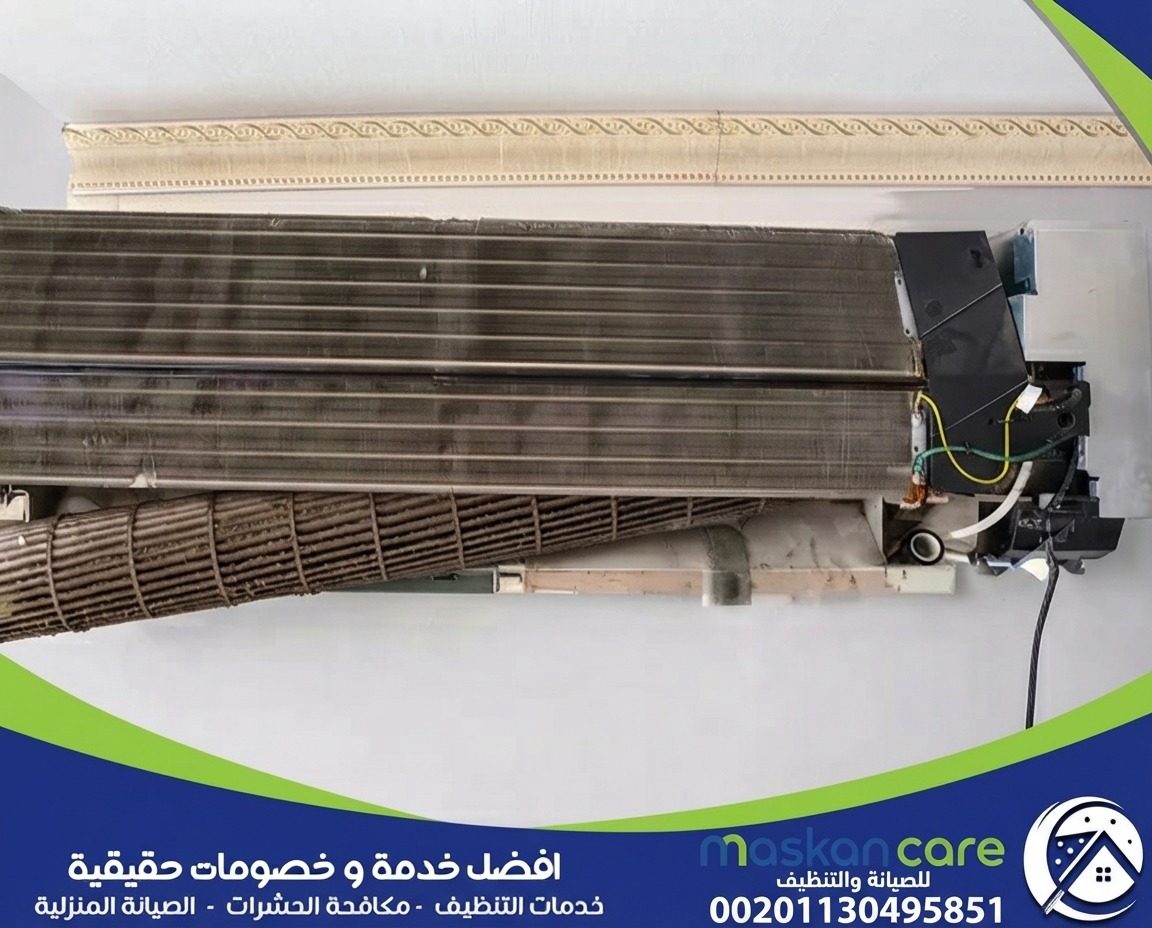
Dirty Cooling Coils
Cooling coils need to be kept clean to ensure effective heat transfer.
When dust and dirt accumulate on the coils, heat transfer efficiency may decrease, causing the system to operate for longer periods to achieve the same level of cooling.
Dirt buildup on condenser coils can also increase the load on equipment and reduce operating efficiency.
Therefore, cleaning and inspecting coils is an important part of preventive maintenance.
Low Refrigerant Level or Refrigerant Leakage
In some air conditioning systems that use a direct refrigerant circuit, a low refrigerant charge caused by leakage can reduce cooling capacity.
The problem may appear as gradually weaker cooling or prolonged AC operation.
Refrigerant should not simply be added without identifying the cause, because a low charge may be the result of a leak that needs to be located and repaired.
Air Leakage from Ductwork
Air ducts are an essential part of the distribution system. Any leakage can cause some of the conditioned air to be lost before it reaches the required areas.
Some leaks may occur in concealed sections that are difficult to identify by simply looking inside the room.
When the duct network is extensive, leakage can affect multiple areas of the building.
Therefore, inspecting air ducts, insulation, and connections can help identify some causes of poor cooling distribution.
Poor Insulation of Air Ducts or Cooling Pipes
Insulation plays an important role in reducing heat gain and maintaining system efficiency.
If insulation becomes damaged or inadequate, more heat may reach the conditioned air or chilled water during distribution.
The problem may appear as gradually reduced cooling efficiency or condensation on certain sections of pipes or ductwork.
Fan or Belt Problems
Air Handling Units rely on fans to distribute air throughout the building.
If there is a problem with the fan, belt, bearings, or motor, airflow may decrease.
In some cases, unusual sounds or vibrations may appear before the component stops operating completely.
Therefore, inspecting mechanical components can help identify problems before an unexpected shutdown occurs.
Pump Problems in Chilled Water Systems
In central AC systems that use chilled water, pumps play an essential role in moving water between cooling equipment and Air Handling Units.
Any problem with a pump, valve, or flow rate can affect the amount of cooling delivered to different parts of the building.
Inspecting pumps and checking pressure and flow readings can help determine whether the problem is located in the central cooling system or in the distribution stage.
Sensor and Control Problems
Large building systems often rely on sensors and control devices to regulate temperatures and operate equipment.
If a sensor provides an inaccurate reading, the system may make inappropriate operating decisions.
This can lead to overcooling in some areas and insufficient cooling in others.
Communication problems with the Building Management System (BMS) can also affect system operation.

Incorrect Control System Settings
Even when equipment is in good condition, inappropriate settings can lead to poor performance.
The system may be configured with temperatures or operating schedules that do not match the building's actual usage.
Studies of large buildings emphasize the importance of adjusting HVAC settings according to actual cooling demand rather than operating the system continuously in a fixed manner that does not reflect real loads.
Increased Thermal Loads on the Building
Building usage may change over time.
New electrical equipment may be added, the number of employees may increase, spaces may be reorganized, or previously unused areas may become occupied.
These changes can increase the thermal load on the HVAC system.
In some cases, the system may have been suitable for the original building design but may no longer be adequate for its current usage.
Unbalanced Air Distribution
In large buildings, air needs to be distributed appropriately among different zones.
If some air outlets receive more airflow than necessary while other areas receive less, temperature differences may occur.
The problem may be related to air dampers, duct design, VAV settings, or overall system balancing.
Inspecting AHUs in Large Buildings in Jubail
Air Handling Units (AHUs) are important components of central HVAC systems because they process air and help distribute it throughout the building.
Dirt buildup on filters, coils, or fans can reduce the efficiency of the unit.
Problems with belts, motors, or controls can also affect the amount of air delivered to different areas.
Therefore, an inspection should include checking the condition of the unit, filters, coils, fan, drainage components, and control devices according to the type of AHU.
Regular monitoring of AHU performance is particularly important in large buildings containing multiple units.
Inspecting Chillers and Central Cooling Systems in Jubail
Some large buildings rely on chillers to produce chilled water that is distributed to Air Handling Units and other AC units.
Chillers are among the most important components of the system, and any reduction in their efficiency can affect large areas of the building.
Poor performance may be associated with dirty heat exchangers, chilled water flow problems, operating an unsuitable number of chillers, compressor problems, or control system issues.
Operating chillers at unsuitable low part-load conditions can also affect system efficiency, as indicated by field research on HVAC systems in large buildings.
Inspecting Air Ducts in Large Buildings
Duct networks in large buildings can extend over long distances and serve numerous rooms, offices, and zones.
Therefore, leakage, blockage, or damage in one section of the network can affect the performance of multiple areas.
During inspection, attention should be given to connections, insulation, dampers, air outlets, and accessible sections of the ductwork.
The performance of different zones can also be compared to determine whether there is an unusual difference in air distribution.
Inspecting the BMS Control System for Central AC
The Building Management System (BMS) helps monitor and operate many building systems, including HVAC systems in facilities that use this technology.
If there is an incorrect sensor reading, an improper setting, or a communication problem between systems, AC units may not operate as required.
The air conditioning equipment itself may be mechanically sound, while the control system prevents it from achieving the expected performance.
For this reason, inspecting the BMS, sensors, and control settings should be part of diagnosing certain central HVAC problems in large buildings.
MaskanCare's Steps for Inspecting Poor Central AC Performance
The inspection process follows organized steps that help identify the cause of poor performance instead of replacing parts or performing maintenance without confirming the actual problem.
● Initial assessment: Understanding the building type, size, usage, and existing HVAC system.
● Reviewing symptoms: Identifying the areas experiencing poor cooling and determining when the problem occurs.
● Inspecting AC equipment: Checking AHUs, FCUs, chillers, and related components according to the existing system.
● Inspecting filters: Checking their condition and their effect on airflow.
● Inspecting coils: Reviewing coil cleanliness and overall condition.
● Inspecting fans and motors: Monitoring performance, unusual sounds, and vibrations.
● Inspecting air ducts: Looking for leaks, obstructions, or insulation problems.
● Inspecting pumps and valves: For systems that use chilled water.
● Inspecting control systems: Reviewing sensors, settings, and the BMS when available.
● Reviewing temperatures: Comparing supply and return air temperatures and temperatures in different zones when required.
● Identifying the cause: Determining which component or components are affecting system performance.
● Performing the required maintenance: Cleaning, repairing, or adjusting components according to their condition.
● Testing the system: Operating the system after maintenance and monitoring its performance.
● Final review: Confirming improvement and reviewing future recommendations.
Importance of Preventive Maintenance for Central AC Systems in Jubail
Preventive maintenance is not only intended to repair the AC system when it stops working. It also helps monitor its condition before major failures occur.
This is particularly important in large buildings because of the number of pieces of equipment, the length of distribution networks, and the multiple zones that depend on the system.
Preventive maintenance programs generally include cleaning filters and coils, inspecting electrical and mechanical components, monitoring temperatures and pressures, checking drainage systems, and reviewing control systems according to the type of HVAC system.
Recording inspection and maintenance results also helps building management track performance changes and identify components where problems occur repeatedly.

Signs That Your Central AC System Requires Professional Inspection
Certain signs should not be ignored when they appear.
The most important include:
● Poor cooling in more than one area.
● Significant temperature differences between floors.
● Unusually high electricity consumption.
● Long AC operating times without reaching the required temperature.
● Reduced airflow.
● Unusual sounds or vibrations.
● Water leakage near AC units.
● Repeated failures of the same unit.
● A specific room remaining hot despite the AC operating.
● Problems appearing after changes to the building layout or increased loads.
● Repeated control system failures.
● Frequent shutdowns of AC units or chillers.
In these situations, a comprehensive inspection is preferable to waiting until the entire system stops operating.
Tips for Maintaining Central AC Performance in Large Buildings
To maintain the efficiency of a central HVAC system, the following practical steps can be followed:
● Clean or replace filters according to their condition.
● Clean coils regularly.
● Monitor AHU and FCU performance.
● Inspect fans, motors, and belts.
● Monitor pumps in chilled water systems.
● Inspect air ducts and insulation.
● Monitor temperatures in different zones.
● Monitor electricity consumption.
● Do not ignore unusual sounds or vibrations.
● Inspect sensors and control devices.
● Review BMS settings regularly.
● Keep records of maintenance and repairs.
● Establish a preventive maintenance schedule appropriate for the size of the building.
● Address minor problems before they affect the rest of the system.
Is Cleaning the Filters Enough to Improve Central AC Performance?
Cleaning filters is an important step, but it is not a solution for every central HVAC problem.
If the problem is caused by a dirty filter, cleaning it may improve airflow.
However, if the problem is related to coils, fans, ductwork, pumps, chillers, or the control system, cleaning the filter alone will not solve the underlying issue.
Therefore, the HVAC system should be viewed as an interconnected group of components.
The AC system may perform poorly even when the filters are clean because the problem may exist elsewhere in the system.
This is why comprehensive inspection is important to identify the actual cause before selecting the appropriate solution.

Impact of Weather and Dust in Jubail on Central AC Performance
The climatic conditions in the region cause HVAC systems to operate under high demand during periods of extreme heat.
Dust and dirt can also affect filters, coils, and outdoor components if they are not properly monitored and cleaned.
In large commercial buildings that operate for long periods, the cumulative effect of these factors can gradually reduce system performance.
Therefore, HVAC systems in Saudi environments require maintenance programs that are adapted to local climate and usage conditions rather than relying only on maintenance when a breakdown occurs.
Central AC Inspection and Maintenance Prices for Large Buildings in Jubail
There is no fixed price for all central AC inspection and maintenance services because the cost varies depending on the building size, system type, equipment condition, and number of units.
The main factors that can affect the cost include:
● Building area.
● Number of AC units.
● Number of AHUs and FCUs.
● Number of chillers.
● Length of the duct network.
● Length of the chilled water network.
● Condition of filters and coils.
● Condition of fans and pumps.
● Presence of control system faults.
● Need for BMS inspection.
● Amount of cleaning required.
● Components requiring repair or replacement.
● Whether the service involves inspection only or comprehensive maintenance.
Therefore, understanding the details of the HVAC system and the building's condition helps determine the appropriate service and provide a more accurate cost estimate.
Book Central AC Inspection and Maintenance Service in Jubail
If you begin to notice poor cooling in certain areas, increased electricity consumption, longer AC operating times, or temperature differences between floors, do not wait until the system stops working or a major failure occurs.
The problem may be simple and can be addressed by cleaning or adjusting a component, or it may be related to another part of the system that requires more detailed inspection.
Early inspection helps identify the actual cause of the problem instead of relying on assumptions or replacing parts without confirming that they are necessary.
MaskanCare provides central AC inspection and maintenance services and HVAC services for large buildings in Jubail, focusing on AC units, chillers, air ducts, fans, pumps, and control systems according to the type and condition of the HVAC system.
For contact and booking:
Phone: 00201130495851
WhatsApp: +00201130495851
Customers can contact MaskanCare to explain their HVAC problem or send photos and system information to receive an initial assessment of the required service.