How to Choose the Right Insulation for Underground and Rooftop Water Tanks in Al Ahsa? 00201130495851 خدمة سريعة وبأرخص الأسعار
A practical guide to choosing the right insulation for underground and rooftop water tanks in Al Ahsa, including the difference between waterproofing and thermal insulation, the most commonly used insulation materials, the main application steps, and essential tips for maintaining your water tank.
How to Choose the Right Insulation for Underground and Rooftop Water Tanks in Al Ahsa?
Water tanks have different insulation requirements depending on their location, construction material, exposure to heat and moisture, and intended use. Therefore, choosing the right type of insulation is not simply about selecting a specific insulation material. It starts with understanding the condition of the tank and the environmental factors surrounding it.
In Al Ahsa, water tanks require special attention due to the region's high temperatures and continuous exposure to weather conditions, especially for rooftop tanks. Underground tanks, on the other hand, face different challenges, such as soil moisture, surrounding pressure, and the possibility of water accumulating around the tank. This is why the right insulation material should be selected based on the tank's location, type, condition, and intended use.
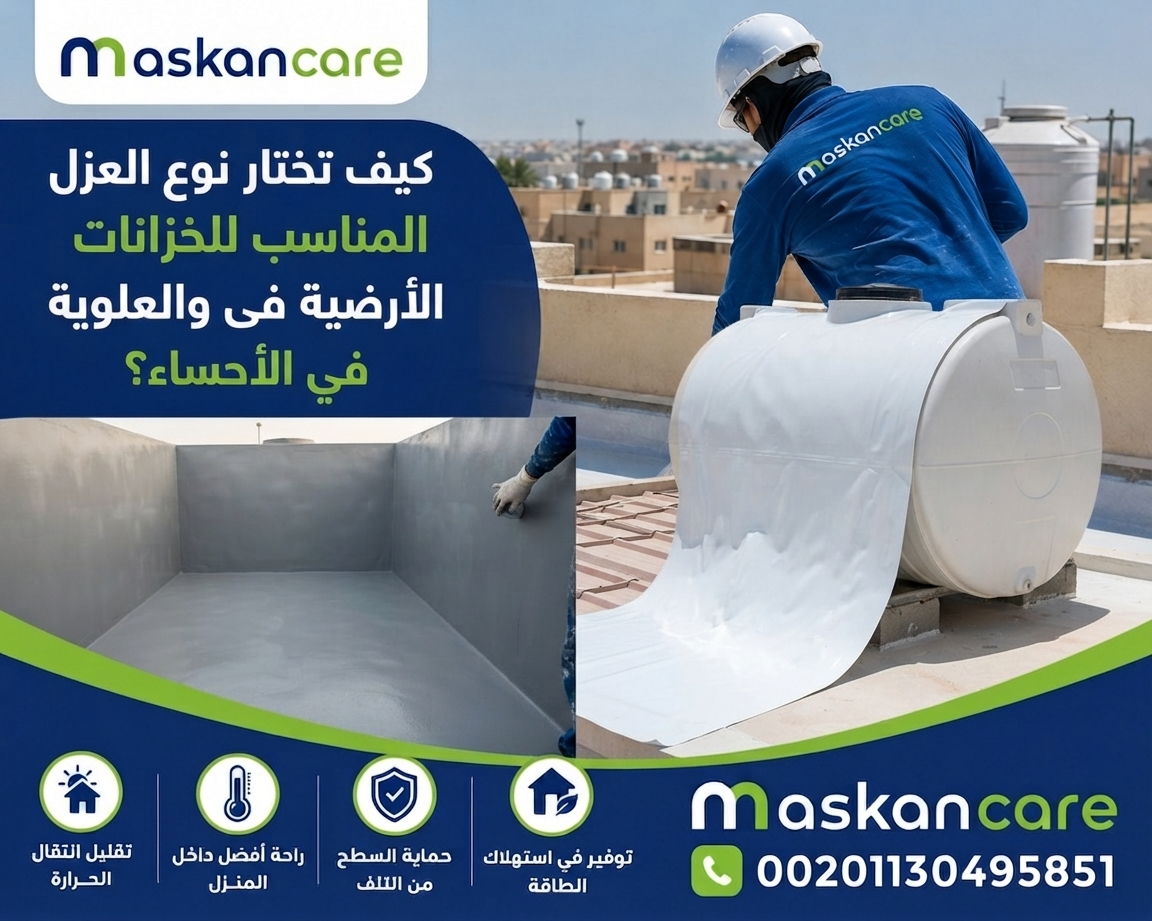
MaskanCare provides water tank insulation services in Al Ahsa, working with both underground and rooftop tanks according to the condition of each tank and selecting the appropriate insulation method based on the surface, usage, and source of the problem.
Best Water Tank Insulation Company in Al Ahsa
When looking for a water tank insulation company in Al Ahsa, choosing a service provider based on price alone is not enough. Proper insulation starts with inspecting the tank and identifying its actual requirements before applying any material.
For example, a tank may require waterproofing from the inside, while its exterior may need a different type of protection. A rooftop tank may also require a combination of waterproofing and thermal insulation to reduce the effect of high temperatures. An underground tank, meanwhile, may require special attention to external insulation because of its contact with soil and moisture, in addition to internal insulation if there is a possibility of water leakage or concrete deterioration.
The condition of the tank itself also plays an important role. If cracks or damaged areas are present, they should be addressed before applying insulation layers. Applying an insulation material over an existing problem may not provide a sufficient long-term solution.
For this reason, MaskanCare evaluates the tank first and then determines the most suitable insulation type and application method instead of using the same solution for every tank.

Why Is Underground Tank Insulation Different from Rooftop Tank Insulation?
The main difference between underground and rooftop water tanks is the environment surrounding each one.
An underground tank is located within the soil or below ground level. As a result, it may be exposed to soil pressure and surrounding moisture. This makes external insulation and moisture protection important parts of the overall protection system.
A rooftop tank, however, is usually directly exposed to sunlight, heat, air, and changing weather conditions. Therefore, thermal insulation may be needed in addition to waterproofing, especially when the tank is located in an exposed area.
This means that the right question is not simply: What is the best insulation material for water tanks? Instead, the better question is: What type of insulation is suitable for this particular tank and its surrounding conditions?
Saudi water efficiency and conservation guidelines also include requirements and technical references related to water tanks, concrete tank lining, and materials used with drinking water. This highlights the importance of selecting materials that are appropriate for their intended application.
How Do You Choose the Right Insulation for an Underground Water Tank?
Underground tanks require several factors to be considered before selecting an insulation material because their location below ground makes them different from rooftop tanks.
Some of the most important factors include:
-
The type of tank, whether concrete, plastic, or another material.
-
The condition of the walls and floor.
-
The presence of cracks, pores, or leaks.
-
The level of moisture around the tank.
-
The type of surrounding soil.
-
Whether the tank is used for drinking water.
-
Whether internal insulation, external insulation, or both are required.
-
The age of the tank and whether it has experienced previous problems.
For underground concrete tanks, some insulation systems use cement-based materials internally and suitable external materials to protect the concrete from surrounding moisture. Other materials, such as epoxy, may be used when a smooth and water-resistant internal surface is required.

Internal Insulation for Underground Water Tanks
Internal insulation is particularly important because it directly interacts with the surface inside the tank.
When the tank is used for drinking water storage, it is essential to make sure that the insulation material is suitable for this purpose and is not simply a material that resists water. Materials that come into contact with drinking water should be appropriate for this application and comply with relevant requirements and specifications.
Some materials used in certain concrete water tank insulation systems include:
Cement-Based Insulation
Cement-based insulation can be used for concrete water tanks. It has the ability to bond with concrete surfaces and create a layer that helps reduce water penetration.
It can be an appropriate option for underground tanks, particularly when the main surface being treated is concrete.
However, the success of an insulation system does not depend on the material alone. Proper surface cleaning, repairing defects, and preparing the surface before application are all important steps for achieving better results.
Epoxy Insulation for Water Tanks
Epoxy is used in some internal water tank insulation applications, particularly when a smooth, easy-to-clean surface with resistance to water and certain chemicals is required.
When epoxy is used in drinking water tanks, it is important to select a product specifically designed and approved for this type of application rather than using any general-purpose commercial epoxy.
External Insulation for Underground Water Tanks
The exterior of an underground water tank is exposed to conditions that are different from those inside the tank. Therefore, it may require an insulation system specifically designed to resist moisture present in the surrounding soil.
Some insulation systems use bituminous materials on the external sides of the tank, particularly during construction and before backfilling. The purpose is to create a protective barrier that helps shield the concrete from surrounding moisture.
It is important to understand that external insulation is not automatically a replacement for internal insulation. Each serves a different purpose depending on the tank design and the source of the problem.
If an underground tank is experiencing leakage or moisture issues, identifying the source of the water first can help determine the appropriate insulation system instead of treating the problem randomly.
How Do You Choose the Right Insulation for a Rooftop Water Tank?
Rooftop tanks face completely different conditions because they are often directly exposed to sunlight and high temperatures.
In Al Ahsa, thermal protection becomes an important consideration for tanks installed on rooftops or in exposed locations, in addition to protection against water leakage.
The appropriate insulation for a rooftop tank can be selected based on:
-
The type of tank.
-
Whether the tank is exposed or located in a protected area.
-
The level of direct sunlight exposure.
-
The material from which the tank is made.
-
The presence of cracks or leaks.
-
The desired water temperature.
-
Whether waterproofing, thermal insulation, or both are required.
-
The type of water stored inside the tank.
Some insulation systems use polyurethane or foam in external applications where the main objective is to reduce heat transfer. Epoxy and other materials may also be used inside the tank depending on the surface type and intended use.
Thermal Insulation for Rooftop Water Tanks
One of the common issues homeowners may notice with rooftop tanks is that the water becomes very hot during summer, especially when the tank is fully exposed to direct sunlight throughout the day.
This is where it is important to understand the difference between waterproofing and thermal insulation.
Waterproofing is primarily designed to reduce or prevent water leakage, while thermal insulation focuses on reducing heat transfer to the tank and the water stored inside it.
Therefore, a rooftop tank may require a system that combines both waterproofing and thermal insulation, particularly when it is installed in a fully exposed location.
Foam and polyurethane are used in some thermal insulation applications for water tanks. However, the material and application method should always be selected according to the tank's location, construction, and intended use.
What Are the Best Water Tank Insulation Materials in Al Ahsa?
There is no single material that can be considered the best option for every water tank because the appropriate choice depends on the tank's condition and location.
The most common options can be summarized as follows:

|
Insulation Type |
Potential Application |
Main Advantage |
|
Cement-Based Insulation |
Concrete water tanks |
Good adhesion to concrete |
|
Epoxy |
Suitable internal surfaces |
Smooth surface and water resistance |
|
Bitumen |
External insulation for underground tanks |
Resistance to surrounding moisture |
|
Polyurethane |
Certain external and thermal insulation applications |
Flexibility and thermal insulation |
|
Foam |
Rooftop and exposed tanks, depending on the system |
Reduces heat transfer |
|
Fiberglass |
Certain tank types and applications |
Good resistance depending on the system used |
These options should not be considered a fixed list that applies to every tank. The appropriate material should be selected based on the surface, the problem being treated, and the tank's location.
Difference Between Waterproofing and Thermal Insulation for Water Tanks
A common mistake is to treat waterproofing and thermal insulation as if they were the same thing.
Waterproofing
The main purpose of waterproofing is to reduce or prevent water leakage into or out of the tank and protect the tank structure from moisture depending on where the waterproofing layer is installed.
It is particularly important for underground tanks that may be exposed to surrounding moisture, as well as tanks that already show signs of leakage.
Thermal Insulation
Thermal insulation is designed to reduce heat transfer between the surrounding environment and the tank.
It becomes especially important for exposed rooftop tanks that receive direct sunlight. Therefore, thermal insulation can be an important part of the tank protection system depending on its condition and location.
This is why choosing the right insulation should not begin with the material itself. It should begin by identifying the problem that needs to be solved.
Water Tank Insulation Process in Al Ahsa
To achieve an appropriate insulation result, the work should be carried out through an organized process rather than simply applying the material directly to the surface.
The process generally includes:
-
Initial Inspection: Inspecting the tank and identifying its type and location.
-
Problem Identification: Determining whether the issue involves leakage, moisture, heat, or cracks.
-
Tank Cleaning: Removing dirt, deposits, and layers that could prevent proper adhesion of the insulation material.
-
Defect Repair: Repairing cracks and damaged areas before applying insulation.
-
Material Selection: Choosing the appropriate insulation type based on the tank's condition.
-
Insulation Application: Applying the required insulation layers using the proper method for the surface.
-
Final Inspection: Checking that all targeted areas have been properly covered and that no areas have been left untreated.
-
Tank Testing: Carrying out the appropriate checks to confirm the insulation system has been properly completed before the tank is returned to use.
Proper surface preparation and crack repair are important steps before applying insulation, particularly for concrete water tanks.

Benefits of Choosing a Specialized Water Tank Insulation Company in Al Ahsa
Choosing a specialized company can help prevent the problem of using a material that may be suitable in theory but unsuitable for the actual condition of the tank.
Some of the main benefits include:
-
Inspecting the tank before selecting the insulation type.
-
Working with both underground and rooftop water tanks.
-
Selecting materials according to the surface and intended use.
-
Providing internal and external insulation when required.
-
Addressing cracks and defects before insulation application.
-
Combining waterproofing and thermal insulation when necessary.
-
Reducing the possibility of having to redo the insulation because of an unsuitable material.
-
Helping maintain the tank for a longer period with proper maintenance.
MaskanCare provides water tank insulation solutions in Al Ahsa and can handle tanks of different sizes and locations according to the requirements of each case.
Mistakes to Avoid When Insulating Water Tanks
Several common mistakes can affect the final insulation result. The most important ones include:
Choosing the material based only on price:
The cheapest material is not necessarily the right material for the type of tank or the problem being treated.
Applying insulation to an improperly prepared surface:
Dust, grease, weak areas, or damaged surfaces can affect the adhesion of the insulation layer.
Ignoring cracks:
Insulation is not a replacement for repairing structural defects or cracks in the tank.
Using a material that is not suitable for drinking water:
If the tank is used to store drinking water, the insulation material must be confirmed as suitable for this application.
Focusing on the inside while ignoring the outside:
For underground tanks, external moisture can be an important factor, so both sides of the tank should be evaluated when necessary.
Treating thermal insulation as a replacement for waterproofing:
Each type of insulation has a different purpose, and some tanks may require a system that combines both.
How Do You Know If Your Water Tank Needs Re-Insulation?
There are several signs that may indicate that a water tank needs to be inspected.
These include moisture or leakage around the tank, an unexplained drop in water level, cracks in the tank, or visible deterioration of the internal insulation layer.
For rooftop tanks, heavy exposure to sunlight and heat can also be a reason to inspect the thermal insulation system, especially when the tank is completely exposed.
For underground tanks, problems may appear as surrounding moisture, water leakage, or deterioration of the external protective layer.
In all cases, it is better to inspect the tank rather than wait until the problem becomes more serious.
Water Tank Insulation Prices in Al Ahsa
There is no single fixed price that applies to all water tanks because insulation costs vary depending on the work required.
Some of the factors that can affect the price include:
-
Tank size.
-
Tank type.
-
Insulation material.
-
Whether the insulation is internal or external.
-
Surface condition.
-
Presence of cracks or leaks that require repair.
-
Whether thermal insulation is required in addition to waterproofing.
-
Number of insulation layers required.
-
Difficulty of accessing the tank.
-
Whether an existing tank needs re-insulation or a new tank is being insulated.
Therefore, understanding the tank's specifications or carrying out an inspection can help determine the required service and provide a more accurate cost estimate instead of relying on a fixed price that may not suit every situation.
MaskanCare Tips for Maintaining Water Tank Insulation
Installing insulation does not mean that the tank no longer needs regular attention.
To help maintain its condition, consider following these tips:
-
Clean the water tank regularly.
-
Monitor any unusual decrease in the water level.
-
Inspect the tank if signs of moisture or leakage appear.
-
Avoid using cleaning products that could damage the insulation layer.
-
Make sure the tank cover is secure and properly closed.
-
Inspect rooftop tanks after periods of extreme heat.
-
Do not ignore visible cracks or damage.
-
Schedule regular maintenance based on the age and condition of the tank.
Choosing the appropriate insulation material from the beginning can also help achieve better and more reliable results, especially when the work is carried out after properly inspecting the tank and identifying its actual requirements.

Book Water Tank Insulation Service in Al Ahsa
If you are looking for the right way to insulate an underground or rooftop water tank in Al Ahsa, start by identifying the tank type, its condition, and the source of the problem. The insulation system should then be selected based on these factors.
MaskanCare provides water tank insulation services in Al Ahsa for both underground and rooftop tanks, with suitable insulation solutions selected according to the tank type, location, and intended use.
The goal is not simply to apply an insulation layer. The goal is to establish an appropriate protection system that helps reduce leakage, limit the effects of moisture and heat, and maintain the tank in better condition.