Water Tank Insulation in Al Khobar – The Importance of Insulation for Protecting Your Tank 00201130495851 خدمة سريعة وبأرخص الأسعار
A comprehensive guide to water tank insulation in Al Khobar, covering the importance of protecting water tanks from leakage, moisture, and heat, the main insulation options, preparation and installation stages, and practical maintenance advice
Water Tank Insulation in Al Khobar and Its Importance
Water tank insulation in Al Khobar is an important service for protecting water tanks and reducing problems that may develop because of leakage, moisture, heat, and surrounding environmental conditions. A water tank is not simply a container used to store water. It is an important part of a property's water system, and any problem affecting its condition can eventually interfere with daily water use or affect the surrounding areas.
Water tank problems may begin with relatively minor signs, such as moisture around the tank, an unexplained decrease in the water level, or cracks appearing in certain areas. In other situations, the main concern may be excessive water temperature caused by direct exposure to sunlight, especially when the tank is installed in an exposed location.
This is where an appropriate insulation system can become useful. Proper insulation can help protect the tank structure and reduce its exposure to external moisture. Depending on the selected system, thermal insulation can also help reduce the effect of high temperatures on the tank.
However, insulation should not begin by simply selecting a material and applying it to the tank. The tank should first be inspected to determine whether there are leaks, cracks, damaged layers, or other problems that need to be addressed before insulation.
Special attention should also be given to the materials selected for water tanks. Any product used inside a tank or in direct contact with stored water should be suitable for that application according to the manufacturer's specifications and the intended use.
For this reason, working with a specialized service provider can help property owners assess the actual condition of the tank before deciding on an insulation system.
Why Do Water Tanks Need Insulation?
Water tanks are continuously exposed to different conditions that can affect their condition over time.
A tank installed outdoors may be exposed to direct sunlight and high temperatures. A buried tank may instead be exposed to surrounding moisture and soil pressure, depending on its location and construction.
Some tanks may also develop leakage because of cracks, damaged areas, weak points, or problems around connected pipes and fittings.
The main reasons for considering water tank insulation include:
-
Reducing the possibility of water leakage.
-
Protecting the tank from external moisture.
-
Reducing the effect of heat when an appropriate thermal insulation system is used.
-
Protecting external layers from certain environmental conditions.
-
Reducing the possibility of moisture affecting surrounding surfaces.
-
Supporting the long-term condition of the tank when insulation and maintenance are carried out correctly.
This does not mean that insulation alone can prevent every possible tank problem. The condition of the tank itself, installation quality, plumbing connections, and the overall water system also play important roles.

The Problem of Water Tank Leakage
Water leakage is one of the most common reasons property owners search for water tank insulation in Al Khobar.
Leakage may occur through the tank body itself, through connection points, or because an existing protective layer has deteriorated.
At first, the leakage may not be obvious. A property owner might simply notice that the water level decreases more frequently than expected without immediately understanding why. Moisture may also appear around the tank.
If the problem continues, moisture can spread to nearby surfaces, particularly when the tank is installed inside an enclosed area or above a building.
For this reason, any unusual sign should be investigated rather than ignored until the leakage becomes more serious.
Signs That Your Water Tank May Have a Problem
Several signs may indicate that a water tank requires inspection or maintenance.
Unusual Water Level Reduction
If the water level decreases noticeably without an obvious reason, it may be useful to check the tank and connected plumbing for possible leakage.
Moisture Around the Tank
Wet areas or accumulated water near the tank may indicate a problem that requires further investigation.
Visible Cracks
Cracks in the tank body or surrounding protective layers should be evaluated, especially if they appear to be growing or returning after previous repairs.
Damaged External Layers
Peeling, separation, or deterioration of external layers may indicate that the tank requires inspection and maintenance.
High Water Temperature
If the tank is directly exposed to sunlight, the stored water may become warmer. In this situation, the property owner can evaluate whether an appropriate thermal insulation solution is needed.
Types of Water Tank Insulation
Water tank insulation systems vary according to the type of tank, its location, and the purpose of the insulation.
Potential solutions include:
-
Waterproofing insulation.
-
Thermal insulation.
-
External tank protection systems.
-
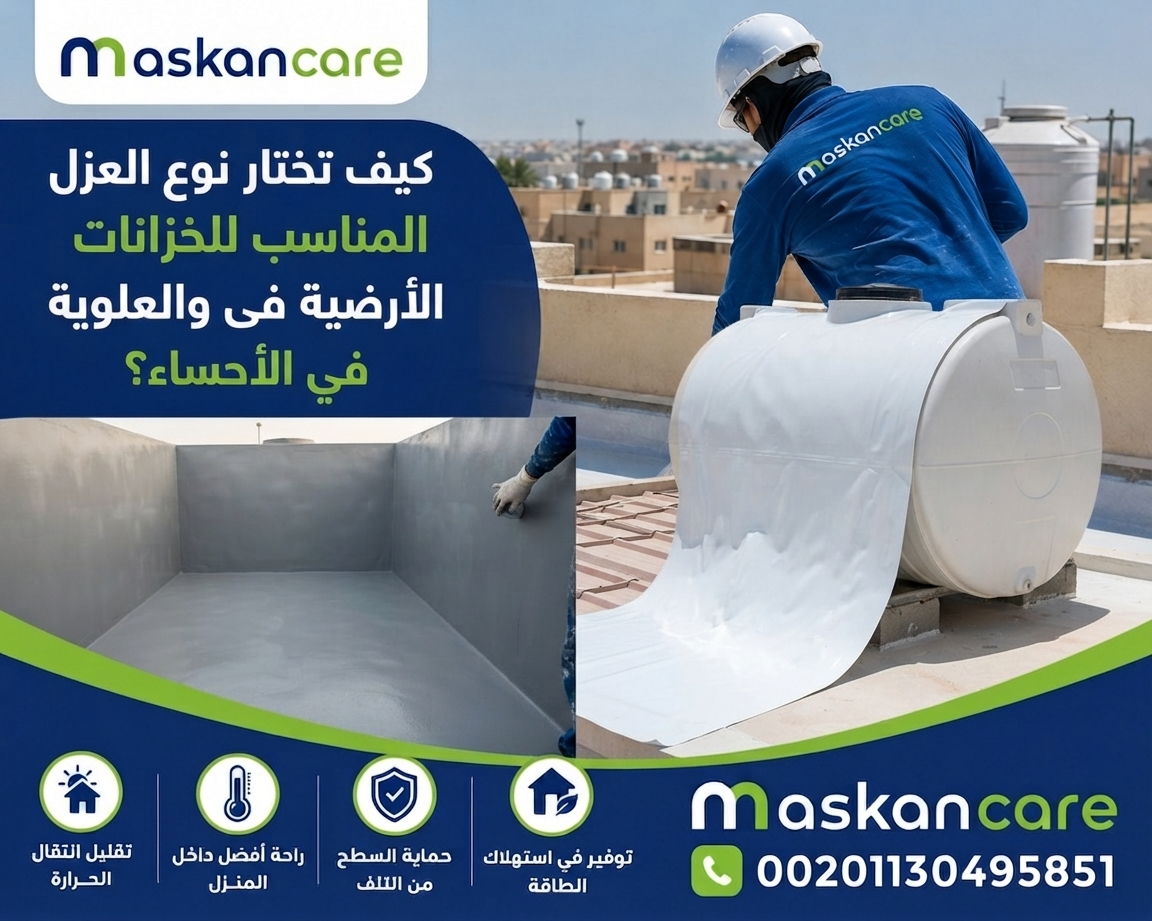
Specialized internal systems when the tank requires internal insulation, provided that the materials are suitable and approved for the intended application.
Selecting the appropriate system should not depend on the material's name alone.
The type of tank, its location, surface condition, and the specific problem should all be considered.
Materials used in areas that come into direct contact with stored water must also be suitable for that purpose according to the manufacturer's specifications and the intended use of the tank.

Waterproofing for Water Tanks
The main purpose of waterproofing is to reduce the possibility of water passing through the tank structure or moisture reaching it from the surrounding environment.
Waterproofing can be particularly important for concrete tanks or tanks installed in areas exposed to moisture.
Before waterproofing begins, however, the condition of the tank should be assessed.
If cracks or damaged areas exist, they should be addressed according to the nature of the problem.
Attention should also be given to pipe connections, openings, and other areas where different components meet, as these points require careful treatment during waterproofing work.
Effective waterproofing depends not only on the material selected but also on surface preparation, application quality, and proper treatment of detailed areas.
Thermal Insulation for Water Tanks
Thermal insulation can be particularly useful for tanks installed in exposed locations.
When a tank remains under direct sunlight for long periods, heat can transfer into the tank body and affect the temperature of the stored water.
An appropriate thermal insulation system can help reduce heat transfer, depending on the tank design and surrounding conditions.
The selected material should be evaluated carefully, particularly when the insulation is installed close to the tank or its water system.
Thermal insulation does not mean that water will remain at a fixed temperature regardless of outdoor conditions. Instead, it can help reduce the effect of external heat depending on the insulation system and the conditions surrounding the tank.
Internal vs. External Water Tank Insulation
It is important to determine where the insulation will be installed before beginning the work.
External insulation is generally intended to protect the outside of the tank from environmental factors and may be appropriate when the main concern involves external moisture or heat.
Internal insulation requires additional care when selecting materials because the insulation layer may come into direct contact with stored water.
For this reason, a product should never be used inside a water tank simply because it is effective at preventing water penetration. It must also be suitable for the specific water storage application, particularly when the tank is intended for drinking water.
Inspecting the Tank Before Insulation
Inspection is one of the most important stages of water tank insulation in Al Khobar.
Without an inspection, insulation could be applied over an existing problem without actually addressing its cause.
During the assessment, the overall tank condition can be examined for leakage, cracks, damaged layers, and other signs of deterioration.
Areas around pipes, openings, and fittings should also be checked.
If the tank already has an old insulation layer, its condition should be evaluated to determine whether it requires repair, removal, or another appropriate treatment.
The purpose of inspection is to understand the actual source of the problem rather than simply covering visible symptoms.
Preparing the Tank Before Insulation
Proper surface preparation plays an important role in the success of insulation work.
The surface should be clean and free from dust, loose materials, and weak layers that could interfere with the insulation system.
If grease, dirt, or other contaminants are present, they should be dealt with using a method appropriate for the tank and the selected insulation system.
Cracks and defects that could affect the insulation should also be treated before application.
If there is an active leak, its source should be identified before a new insulation layer is installed.
Preparation requirements vary depending on the tank type, so there is no single preparation method that is appropriate for every tank.
Water Tank Insulation Process
The exact procedure varies according to the tank type and insulation system, but the work can generally be divided into several main stages.
Assessing the Tank
The tank is inspected to determine its condition, identify the problem, and establish what type of insulation may be appropriate.
Cleaning the Surface
Dust, loose materials, and contaminants that may interfere with insulation adhesion are removed.
Treating Cracks
Cracks and weak areas are addressed before the insulation system is applied.
Preparing Critical Areas
Special attention is given to pipes, openings, corners, joints, and other sensitive areas.
Applying the Insulation System
The selected insulation material or system is applied according to the manufacturer's instructions and the actual tank condition.
Inspecting the Insulation Layer
The completed layer is checked for visible gaps, separation, or other obvious defects.
Testing When Required
Appropriate testing may be performed depending on the tank type and insulation system to evaluate the quality of the completed work.
The Importance of Insulating Concrete Water Tanks
Concrete water tanks require particular attention because concrete can develop cracks and be affected by moisture over time.
Problems may appear as leakage through walls, the tank floor, or connection areas.
A concrete tank should therefore be inspected before an insulation system is selected.
In some cases, cracks or damaged sections need to be repaired before protective layers are applied.
The concrete surface must also be prepared appropriately to support proper application of the selected insulation system.
Insulating Rooftop Water Tanks
Rooftop water tanks are generally exposed directly to sunlight and outdoor conditions.
This makes external thermal insulation one of the solutions that may be considered when heat is a significant concern.
The tank should also be protected from environmental moisture and other external conditions that could affect its condition.
At the same time, insulation should not prevent access to components that may need inspection or maintenance later.
Insulating Underground Water Tanks
Underground tanks differ from rooftop tanks because of the conditions surrounding them.
Depending on their location and construction, underground tanks may be exposed to soil pressure and surrounding moisture.
For this reason, waterproofing and protecting the tank structure from moisture can be important considerations.
However, any underground tank problem requires careful evaluation because some areas may be more difficult to access than those of an exposed rooftop tank.
Does Insulation Protect the Water Inside the Tank?
Proper insulation can help protect the tank from environmental factors that may affect its condition, but insulation itself does not make stored water safe to drink.
Water quality depends on several factors, including the water source, tank cleanliness, plumbing system, storage conditions, and maintenance.
If a tank is intended for drinking water, all materials used inside the tank or in direct contact with the water should be suitable for that purpose according to applicable product specifications and the intended use.
It is also important not to confuse insulation with tank cleaning.
Insulation is intended to protect the tank, while regular cleaning addresses sediment and contaminants according to the tank's maintenance requirements.
The Importance of Cleaning the Tank Before or After Insulation
In some situations, a tank may need to be cleaned before insulation work begins, particularly when sediment or contamination affects the surface condition.
The cleaning method should be appropriate for the tank type and its intended water use.
After insulation work, the tank should not necessarily be returned to service immediately. The manufacturer's instructions for the selected insulation system should be followed, especially if any part of the system is located close to the stored water.
This helps ensure that the tank is used only after the insulation work has been properly completed and any required curing or preparation period has been observed.
Common Mistakes to Avoid When Insulating Water Tanks
Using an Unsuitable Material
Not every insulation product is suitable for water tanks, especially when direct contact with stored water is possible.
Applying Insulation Over a Damaged Surface
If cracks or loose sections are simply covered without being addressed, the underlying problem may continue.
Ignoring Connections
A tank itself may be in good condition while leakage originates from a pipe connection or fitting.
Failing to Prepare the Surface
Dust, loose materials, and weak layers can affect the performance and adhesion of an insulation system.
Choosing Based Only on Price
A lower-priced material is not necessarily suitable for the tank type or the problem being treated.
Neglecting Maintenance
Insulation requires monitoring, particularly when the tank is located outdoors and exposed to changing weather conditions.
How to Maintain a Water Tank After Insulation
Protecting a water tank does not end when the insulation work is completed.
The tank should be inspected periodically, and any new changes should be addressed as soon as they are noticed.
The area around the tank should also be monitored to ensure there is no unusual moisture or accumulated water.
For rooftop tanks, extra care should be taken when carrying out work nearby so that the insulation layer is not damaged.
New drilling, modifications, or installations around the tank should be planned carefully because they can affect existing insulation and waterproofing layers.
When Should You Hire a Professional Water Tank Insulation Company?
Professional assistance may be appropriate when you notice:
-
Repeated water leakage.
-
An unexplained reduction in the water level.
-
Moisture around the tank.
-
Visible cracks.
-
Deteriorated old protective layers.
-
Excessively warm water caused by direct sunlight.
-
The need for a new insulation system.
-
Problems involving underground or concrete tanks that are difficult to access.
A specialized company can assess the tank and determine whether it requires insulation, repair, cleaning, or a combination of services.
Water Tank Insulation in Al Khobar with MaskanCare
When searching for water tank insulation in Al Khobar, it is important to choose a service that evaluates the tank before recommending a solution.
MaskanCare provides building and tank care services with an emphasis on identifying the actual problem before work begins.
If the main concern is leakage, the source of the leakage should first be identified.
If excessive water temperature is the issue, the tank can be assessed to determine whether thermal insulation may be appropriate.
If the tank contains cracks or damaged old layers, these areas may need to be treated before a new insulation system is installed.
The tank type is also an important factor because a concrete tank differs from tanks made from other materials, while an underground tank has different environmental conditions from a rooftop tank.
For this reason, the appropriate solution should begin with an assessment of the actual tank condition rather than simply choosing an insulation product at random.
Why Should Water Tank Leaks Be Addressed Early?
Ignoring a water tank leak can allow the problem to continue for a longer period.
Leaking water may increase moisture around the tank or affect nearby surfaces.
If the leak originates within the tank structure, delaying the inspection may make the problem more difficult to address, depending on its cause and the condition of the tank.
Early identification gives the property owner an opportunity to evaluate the problem and determine an appropriate solution before it develops further.
The Importance of Thermal Insulation for Exposed Water Tanks
A rooftop water tank may remain under direct sunlight for extended periods.
In areas with high temperatures, the effect of sunlight can become more noticeable.
An appropriate thermal insulation system can help reduce heat transfer to the tank and therefore reduce the effect of high outdoor temperatures on the stored water.
However, the insulation system must be suitable for the tank and should allow access for future inspection and maintenance.
It should also not be installed in a way that hides signs of damage that may need to be detected later.
Choosing a Water Tank Insulation Company
Choosing the right company should not depend solely on price.
It is useful to understand the type of service the company provides and whether the process begins with an inspection of the tank.
The materials being used should also be discussed, particularly if the insulation will be installed inside the tank or in an area where it could come into contact with stored water.
A professional recommendation should be based on the actual condition of the tank rather than applying exactly the same system to every customer.
Clear communication about the problem and the proposed solution can help property owners make better decisions.
Water Tank Insulation and Long-Term Maintenance
Proper insulation can be an important part of a long-term water tank protection plan, but it does not eliminate the need for inspection and maintenance.
The tank remains exposed to environmental conditions, while plumbing work or equipment installation nearby can potentially affect insulation layers.
For this reason, new signs of leakage, moisture, cracks, or surface deterioration should be addressed promptly.
The area around the tank should also be kept clean, and unnecessary water accumulation should be avoided.

Conclusion
Water tank insulation in Al Khobar is an important measure that can help protect water tanks and reduce problems associated with leakage, moisture, and heat.
However, effective insulation begins with proper inspection.
The tank's condition should be evaluated, the source of any leakage should be identified, cracks and damaged areas should be addressed, and the surface should be prepared before the appropriate insulation system is applied.
Waterproofing focuses on reducing water penetration and protecting the tank from moisture, while thermal insulation can help reduce the effect of heat, particularly for exposed rooftop tanks.
The selected materials also require careful consideration, especially when the tank is intended to store drinking water. Any material used inside the tank or in direct contact with the water should be appropriate for the intended application according to the manufacturer's specifications.
Insulation should also be followed by periodic inspection and maintenance because the tank remains exposed to environmental conditions and other factors that may affect its condition.
If your water tank is experiencing leakage, moisture, cracks, or noticeably high water temperatures, having the tank professionally assessed can help identify the appropriate solution instead of experimenting with unsuitable insulation materials.
You can contact MaskanCare to discuss your tank's requirements and determine the appropriate service based on its condition, type, and location.
Contact Number: 00201130495851
WhatsApp: https://wa.me/00201130495851
Book the appropriate water tank insulation service and protect your tank by addressing potential problems before they become more serious